(This article was written for Collider.com. In the event that Collider publishes it, it will be available on their site, with a corresponding link to it here at Codemorse. Consider this a "sneak-peek" for faithful readers of this site)
In February, 2004, a little film called “What The Bleep Do We Know?!” was released in exactly two theaters.
From the hotbeds of Yelm, Washington, and Portland, Oregon, “What the Bleep” spread - eventually ending up in 146 theaters across the country. In contrast, Jodi Foster’s latest film, “Flightplan,” was initially released in approximately 3,424 theaters on opening day.
“What the Bleep” (hereafter WTB, to keep the author from losing his mind) was something of a phenomenon. With virtually no mainstream press coverage, a teeny-tiny budget, and no stars (the film features “Academy Award Winner Marlee Matlin.” Its pretty safe to say that Ms. Matlin, though assumedly a lovely person, is not a “Star” in the traditional sense of the word), WTB went on to gross more than ten million dollars in the theater. It’s since raked in cash from international sales and distribution, home video/DVD, and an accompanying book. For a film made on a shoestring, that’s pretty bleepin’ impressive.
So, what’s the film about, anyway? Well, that’s kind of complicated. Let’s ask the film’s website, shall we?:
“Part documentary, part entertaining story, part animation with mind-blowing special effects, What the BLEEP!? defies all attempts at categorization. The storyline and interviews with fourteen of the world’s greatest physicists, doctors, biologists and mystics reveal the quantum underpinnings of human life, where thought affects the fabric of physical reality via infinitely subtle neurological processes.” (link)
Got that? Me neither.
Essentially, WTB is about Marlee Matlin, who wakes up one morning to discover that her thoughts determine the course of, and success in, her life. A bunch of talking heads pop up, from time to time, and offer up “scientific” explanations for why thought is such a powerful tool.
WTB is like a Tony Robbins self-empowerment session, delivered with animated segments and a new-age philosophical bent that wouldn’t be out of place in a shop that sells crystals and “discover your inner wiccan” handbooks.
****
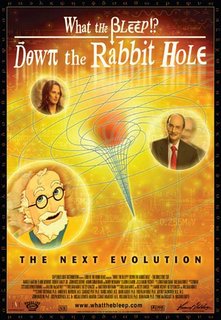
February 3rd marked the release of “What the Bleep?! - Down The Rabbit Hole,” (hereafter DTRH) which, in addition to having one of the most awkward film titles in recent history, is also a sequel-of-sorts to the phenomenally successful “What the Bleep Do We Know?!” I say “sequel-of-sorts,” because DTRH is essentially WTB, repackaged. It’s got more talking heads, more animation, and the same Marlee Matlin storyline.
But why should you care about any of this? Especially if you aren’t the type of person who tends to contemplate their inner power-animal?
Well, it’s because both films are carefully constructed propaganda. What’s more, they’re skillfully and purposefully veiled propaganda. And what they’re selling, beyond the cutesy “We make our own reality” façade, is something deeply, deeply weird.
But don’t take my word for it. Just ask Ramtha.
****
From the WTB website:
“One of the great enigmas that scientists have studied in the last decade is Ramtha, a mystic, philosopher, master teacher and hierophant. His partnership with American woman JZ Knight, his channel, still baffles scholars….[W]hile JZ Knight is channeling Ramtha, the readings of her brain-wave activity shift to delta, and that the lower cerebellum operates her body which talks, walks, eats, drinks and dances while Ramtha teaches – about the mystery of mind over matter.”
If you’ve seen WTB, then you’ve seen this JZ Knight person. Here’s her picture:

She pops up throughout WTB (and, assumedly, throughout DTRH), dispensing little kernels of wisdom. In her free time, she channels a 35,000 year old “mystic” named Ramtha. In the credits to WTB, Ms. Knight is identified as Ramtha, channeled by JZ Knight (this is, sadly, not a joke. You can see it for yourself right here).
Ms. Knight, or Ramtha, or whoever, runs the Ramtha School of Enlightenment, which again appears to be the Tony Robbins experience run through the blender of new-age mysticism, and processed through the “living channel” of JZ Knight. The Ramtha School offers free packets of information, which I was sorely tempted to apply for before eventually freaking out over the idea of these people having my name and address. The School appears to take its cue from other, currently en vogue pop-culture-savvy cults like Kabbalah and Scientology. In fact, the core message of Ramtha’s School is substantially similar:
“Through a coherent system of thought that unifies scientific knowledge with esoteric knowledge of spirit, his students study biology, neurophysiology, neurochemistry and quantum physics. Like Bohm [Ramtha] declares that consciousness is the ground of all being. In his own lifetime 35,000 years ago he learned to separate his consciousness from his body, raise its frequency and eventually take it with him. He has been one of the few human beings to become an eyewitness to the seen, and, the unseen.”
If you stuck the words “Hawaiian volcano,” “Body Thetans,” and “L. Ron Hubbard” in there, you’d have a working description of Scientology, no?
Three of the directors of WTB (how many directors does a film need, exactly?) are students of the Ramtha School of Enlightenment. Many of the professional scientists interviewed in the film are proponents of the Ramtha philosophy (though it’s unclear how many, if any, are explicitly students of Ramtha).
Maybe it’s the hallucinogens talking here, but all of that sounds a bit…wonky to me. Fusing the spiritual with pop-culture is nothing new – the Christian music industry has been doing it for decades – but hiding it is.
WTB is the film equivalent of a Trojan Horse – concealing a very specific, cultish belief system in a movie that pretends to be about something larger. That’s really creepy to me.
The makers of WTB seem to have realized, whether consciously or sub, that most people probably won’t key in to a movie about the glory-that-is-Ramtha, because with the exception of JZ Knight’s bizarre end-credit, Ramtha “himself” is never mentioned in the film. Anywhere.
Maybe this is because what the Ramtha School of Enlightenment has to say about the idea of thought-as-reality is not really specific to Ramtha. The idea of “mind over matter,” after all, has been around for millennia. But given their overt connections to the School, the directors are more likely making a film about their own beliefs; which is that Ramtha is the way to enlightenment.
This brings up all sorts of questions. Do films reflect the beliefs of the filmmaker? If a Christian director makes a movie about the value in charity, selflessness, and Good Works, but doesn’t mention that he’s Christian, is he “hiding” it? Does it matter if he is, as long as people come away from the film feeling better about themselves? Is implicitly advocating a particular philosophy really any “worse” then explicitly pushing for it? Should it matter that the directors of WTB worship some middle-aged lady doing a riff on Whoopi Goldberg’s Ghost routine? Maybe not. But I found the whole back-story to WTB fascinating, and more than a little disturbing.
On some level, it does bother me that “Ramtha” is sitting behind the scenes on this whole thing. That JZ Knight is quietly gathering new converts to her School of Enlightenment. The very qualities that allowed WTB to become such a grass roots success story (namely, the use of the internet as promotional tool, the surface-innocence of its message, and the obscuring of the “religious” notions that inspired it) also allow the movie to disseminate the word of Ramtha easily and effectively. Did you like the movie? Maybe you want to know more? Then visit the website! Oh, and who’s this Ramtha person? Oh, he’s the inspiration for the movie? And I can take classes to learn more? And buy books? And posters? And photos (my personal favorite being “Ramtha in Shade”)? And “Subliminal Tapes and CD’s”? Pretty soon Ramtha’ll have his own energy drinks. Or a line of books for children.
What’s really important to me (and, if one is to judge by the recent “A Million Little Pieces” backlash, to most of America as well) is the truth. Especially when it comes to something as fundamental and as powerful as religion. If someone’s going to sell their religion to me, I want to know I’m being sold to. There’s something inherently sinister about disguising WTB’s origins and inspirations. What does it say about a religion when it attempts to win you over through deception-by-omission?
DTRH premiered Friday, February 3rd, and quite-probably at a theater near you. If you were planning on catching it, maybe it’s important that you know what it is you’re watching. If you had no idea what the bleep these films were all about, well, I hope I’ve entertained. All hail Ramtha!